Author: Carol Kumm
Last updated: Oct 09, 2026
 14024
views
14024
views
Purpose: The purpose of the Pedagogical Framework is to orient audiences to Relay’s pedagogical approach to preparing teachers. It speaks to why we are engaged in this work, what we want our students to know leaving our programs, and how we will develop our students’ knowledge, skills and mindsets. This document describes a holistic instructional approach to teacher preparation that is reflected throughout the design and implementation of Relay’s teacher preparation programs.
RELAY’S MISSION & VISION: Relay’s mission is to ensure that all students are taught by outstanding educators. Our vision is to build a more just world where every student has access to outstanding educators and a clear path to a fulfilling life.
VISION OF A RELAY PREPARED TEACHER: By the end of their program, teachers will possess the knowledge, skills, mindsets and dispositions of a culturally responsive and inclusive educator who is well-versed in subject matter. They will demonstrate their ability to apply and integrate the practices of effective teaching within their discipline by demonstrating proficiency with Relay’s learning outcomes, meeting professional standards, and positively impacting Birth-Grade 12 students’ outcomes.
BIRTH-GRADE 12 STUDENT OUTCOMES: At Relay, we focus on helping teachers improve Birth-Grade 12 student outcomes in three areas: academic achievement, social-emotional learning, and student experience. Research highlights the strong connection among these dimensions and their collective impact on student success (Jackson et al., 2020). By prioritizing all three, Relay equips educators to foster students' holistic development and achievement of both academic and life goals.
Relay’s curriculum is built on evidence-based learning outcomes that define the knowledge, skills, and mindsets educators need to support strong Birth-Grade 12 student outcomes. The outcomes are informed by national (i.e. InTASC Model Core Teaching Standards) and subject-specific teaching standards and reflect a wide range of contemporary research on the science of learning and development, Culturally Responsive Teaching, adult learning, and teacher education.
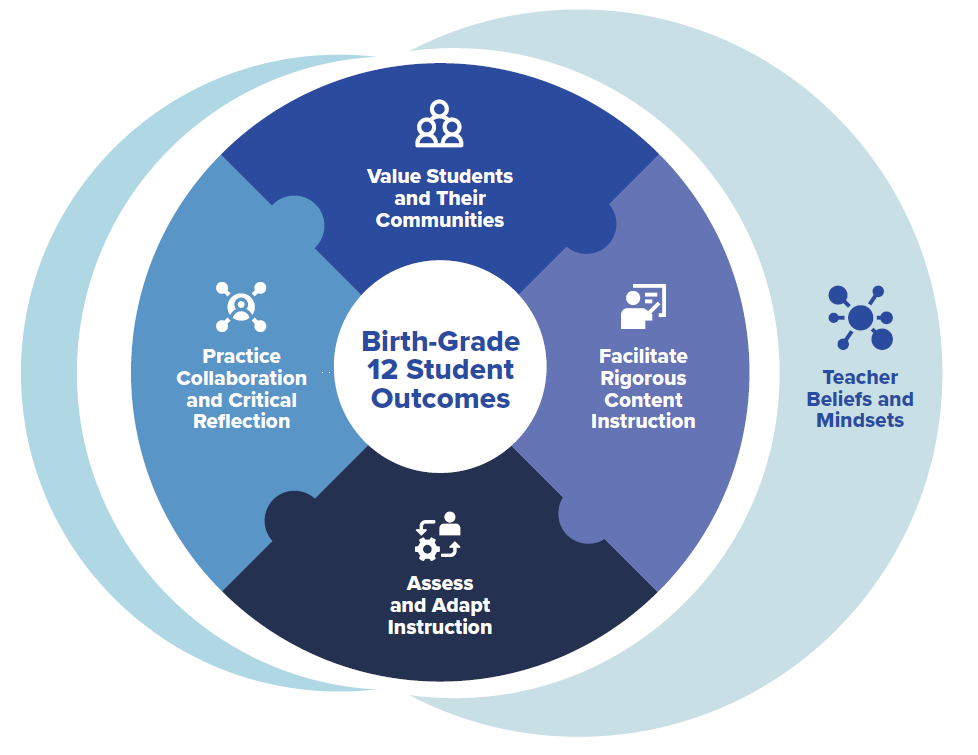
Conceptual Model for the Relay Curriculum: Asset-based beliefs and mindsets guide four key areas of teacher development: valuing students and communities, delivering rigorous instruction, adapting teaching based on assessment, and engaging in collaboration and critical reflection. Relay students develop these competencies to improve student experience, social-emotional development, and academic achievement for Birth-Grade 12 students.
|
TEACHER BELIEFS & MINDSETS
|
|
At Relay, we explicitly support our students in developing the beliefs and mindsets of culturally responsive and inclusive educators. These beliefs and mindsets reflect the understanding that all learners and communities possess assets that should be leveraged to ensure all students have a positive experience and meet ambitious academic and social-emotional goals. Developing these beliefs and mindsets enables Relay students to enact the skills they learn in service of equitable outcomes for all students. These beliefs and mindsets are described in more detail in Appendix A.
|
|
INSTITUTIONAL OUTCOME CATEGORIES
|
|
Value Students and Their Communities:
The knowledge, skills and dispositions that reflect a commitment to seeing students as whole individuals shaped by their identities, experiences, families, and communities. When these knowledge, skills, and dispositions are demonstrated in practice, teachers center learners’ needs so that they feel supported, empowered, and connected to the classroom and school community.
|
|
Facilitate Rigorous Content Instruction:
Educators develop a deep understanding of both content and content-specific instructional practices. Through effective planning, evidence-based teaching, and higher-order thinking opportunities, educators help Birth-Grade 12 students engage deeply with content and make meaningful real-world connections. (Loewenberg Ball, Thames, & Phelps, 2008; Hill, Rowan, & Loewenberg Ball, 2005; Schulman, 1986).
|
|
Assess and Adapt Instruction:
An ongoing cycle in which educators use assessments, collect and analyze data, and adjust teaching practices based on evidence of student learning. Educators use organized data systems and multiple data sources to ensure instruction is responsive to students and focused on promoting growth and achievement for all learners.
|
|
Practice Collaboration and Critical Reflection:
The habits of critical self-examination, inquiry, collaboration, and action that educators apply to continuously strengthen their practice while ensuring every student has access to high-quality educational opportunities.
|
Relay prepares teachers through a practice-based approach that prioritizes the application of knowledge and skills in authentic classroom settings. By connecting theory to daily instructional practice, teachers learn to make effective, evidence-based decisions that support student learning.
|
Relay’s approach to instruction is characterized by the following features:
|
|
EXEMPLARY TEACHING FACULTY
Relay courses are facilitated by exemplary teachers who have demonstrated success in Birth-Grade 12 classrooms, possess deep theoretical and practical knowledge of program-level competencies, and contribute to their respective fields through scholarship. Relay faculty model the habits of mind of a culturally responsive and inclusive educator in their planning, instruction, and support of students. Through shared professional learning opportunities and collaboration, faculty continue to build their expertise to stay current in the field.
|
|
MODEL-PRACTICE-FEEDBACK CYCLES:
Relay faculty members make knowledge, skills, and mindsets visible for teachers by facilitating supported practice. Practice cycles include:
-
STRONG MODELS: Relay teachers develop by observing effective teaching in action. Our instruction includes access to and shared analysis of strong models of the integration of skills and mindsets developed in coursework. The nature of these models varies depending on the nature of the skill (e.g. models of planning may look different from models of delivery) and may be faculty-driven or in the form of written or video case study.
-
DELIBERATE PRACTICE: Teachers transfer theory into classroom implementation through intentional practice of a skill, accompanied by immediate feedback aligned to shared criteria for success and the opportunities apply feedback through repeated practice.
-
SELF-REFLECTION & FEEDBACK: Teachers grow in their practice through direct feedback and self-reflection on their craft. We offer opportunities for expert and peer feedback during asynchronous and synchronous coursework, through conversation with mentors, and on summative assessments.
|
|
INTEGRATING CULTURALLY RESPONSIVE AND INCLUSIVE PRACTICES
Adult learners bring diverse identities, experiences, ways of learning, and teaching contexts to their professional growth. Relay faculty incorporate culturally responsive and inclusive practices by creating opportunities for participants to reflect on and share their identities, experiences, and perspectives. Instruction incorporates examples and case studies that reflect the diversity of the teachers, students, and educational settings we serve. Faculty also use flexible instructional methods and materials, grounded in principles of inclusive design, to support meaningful engagement, reduce barriers to understanding, and support participants’ ability to express their learning.
|


